Body · 9 min read
I spent three years training six days a week. More work equals more gains, right? Except it wasn’t working. My progress plateaued, my recovery got worse, and my energy became inconsistent. When I finally tracked the data, I realized something counterintuitive: the weeks I trained five days with two full rest days were the weeks I got stronger.
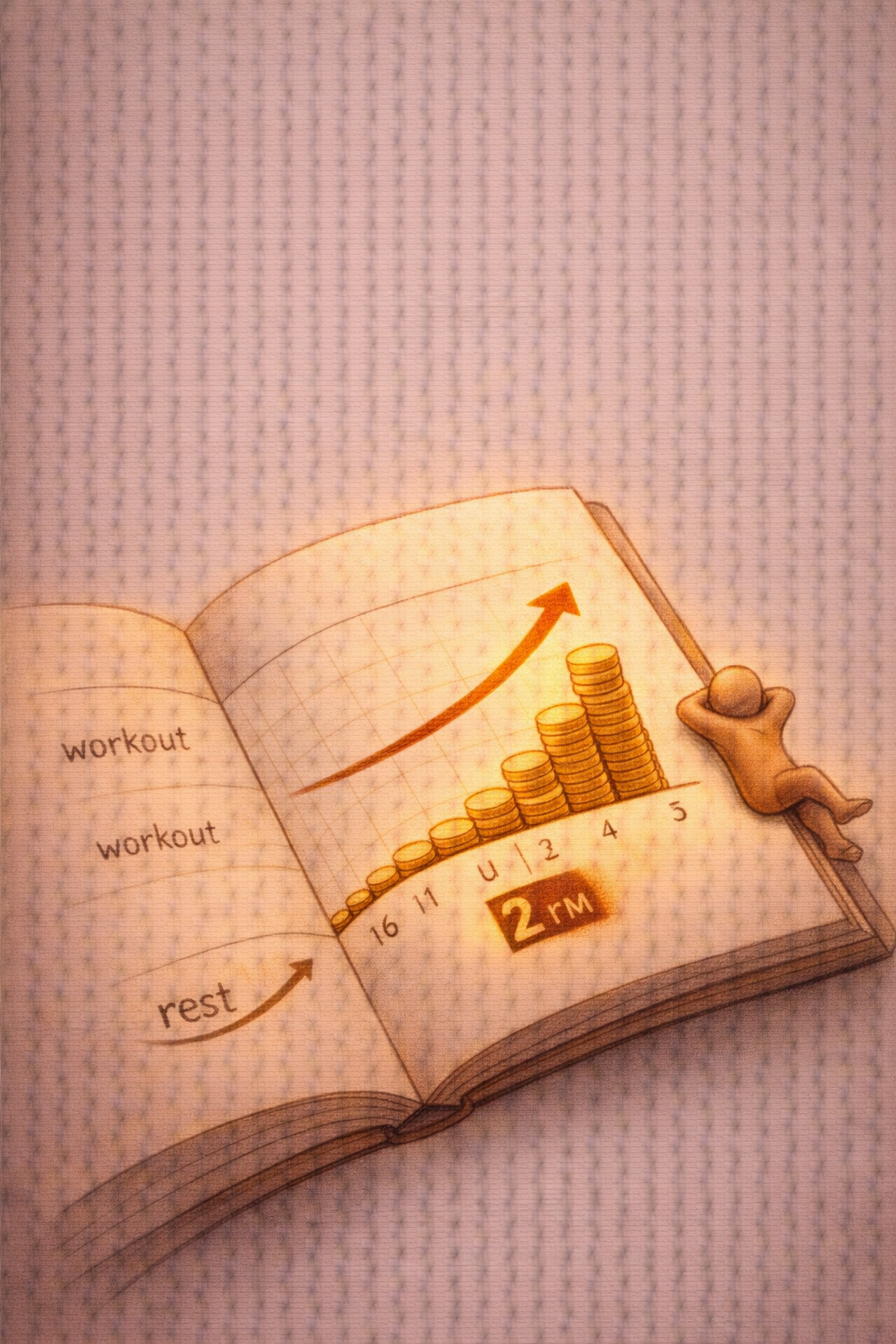
Rest isn’t the absence of progress. It’s where progress actually happens. Understanding this changes everything about how you approach training — and building wealth with your body.
How Training Actually Works
When you train, you create stimulus — mechanical tension, metabolic stress, muscle damage. Your body perceives this as a threat. Cortisol rises. Your sympathetic nervous system activates. You finish the workout tired. That’s the easy part.
The actual growth happens later. In the hours and days after training, your body repairs the damage, builds new muscle proteins, strengthens tendons and connective tissue, improves mitochondrial density, and improves neural efficiency. This adaptation phase is where growth lives. If you don’t allow adequate recovery, you don’t get the adaptation. You just get cumulative fatigue.
The Compound Interest of Rest
Approach A: Train six days a week at 70% effort. Never fully recover. Accumulate fatigue. Your body never fully adapts. Approach B: Train five days a week at 90% effort. Full recovery on rest days. Your body completes the adaptation cycle. You come back stronger.
The second approach does less volume but higher quality work. And quality compounds. After one month, the difference is small. After three months, it’s obvious. After a year, Approach B is significantly stronger. Same body, same genetics. Different recovery structure. Different outcome.
What Rest Actually Does
Sleep rebuilds the nervous system. Deep sleep is when growth hormone peaks, when your brain consolidates motor learning, and when protein synthesis is highest. A trained athlete who sleeps poorly is leaving gains on the table.
Rest days lower cortisol. If cortisol stays elevated because you keep training, your body shifts to a catabolic state — breaking down tissue instead of building it. Rest days signal your body that it’s safe to build rather than just defend.
Recovery improves immunity. Hard training suppresses immune function temporarily. Rest allows immune cells to proliferate and adapt. You get stronger immune function from cycles of hard training plus adequate recovery.
Active recovery accelerates adaptation. Walking, stretching, easy swimming, light yoga — these increase blood flow without creating new stress. A slow walk on a rest day can actually speed up recovery from hard training.
Rest days aren’t a break from progress — they’re when progress happens. The bottleneck isn’t training capacity. It’s recovery capacity. The people who make the best progress don’t train the most. They train the smartest and recover the best.
The Rest Day Hierarchy
Full rest: Zero training. Literally rest. Sleep. Light walking if it feels good. Do this once per week minimum. Active recovery: Very easy movement for 20–30 minutes — walking, stretching, gentle yoga. Low enough intensity that you could sustain it for hours. Do this one to two times per week. Deload week: Once every four to eight weeks, drop to 50% of normal volume. Pure technique work. Your nervous system settles, tendons fully recover, and you come back stronger.
A Sustainable Weekly Structure
Monday: hard training (90%+ effort). Tuesday: medium training (70%) or active recovery. Wednesday: hard training. Thursday: active recovery or rest. Friday: hard or medium training. Saturday and Sunday: one full rest, one active recovery. This gives you three hard sessions per week with adequate recovery between them. It’s sustainable indefinitely, with low injury risk and low burnout.
Your action step for today
Look at your training week right now. Add one full rest day and one active recovery day (easy 20-minute walk, stretching). Track your performance on your hard training days for two weeks. You’ll come back stronger, with more energy and better quality sets. The gains from rest show up the next time you train.
Keep Building
Progressive Overload for Beginners: Building Strength That Compounds · Sleep Hygiene for Better Money Decisions · The Tracking System: How I Monitor Supplements, Sleep, and Energy
American College of Sports Medicine · Mah et al., Sleep (2011), Stanford University · Milewski et al., Journal of Pediatric Orthopaedics (2014)
Leave a Reply