Foundations · 9 min read
Every person I know has a story about the windfall that was going to change everything.
The tax refund that was bigger than expected. The bonus at work. The old car that sold for more than they thought it was worth. The Venmo from a relative with a note that just said “For you.”
I’ve had all of those. And if you’d asked me in my twenties which one changed my life, I would have picked one. It would have been a confident answer.
It would also have been the wrong answer.
Because when I finally sat down a few years back and looked at a spreadsheet of where my money had actually come from — not where I thought it came from — the windfalls were barely a footnote. The money that built my life was the money I almost didn’t notice. Five dollars here. Ten there. An autodraft I set up once and forgot about for four years. A habit I started on a Tuesday that was still quietly working on the Tuesday three years later.
This is the part of personal finance that doesn’t make for a good story, which is exactly why nobody tells it.
Here’s the comparison that changed how I think about money.
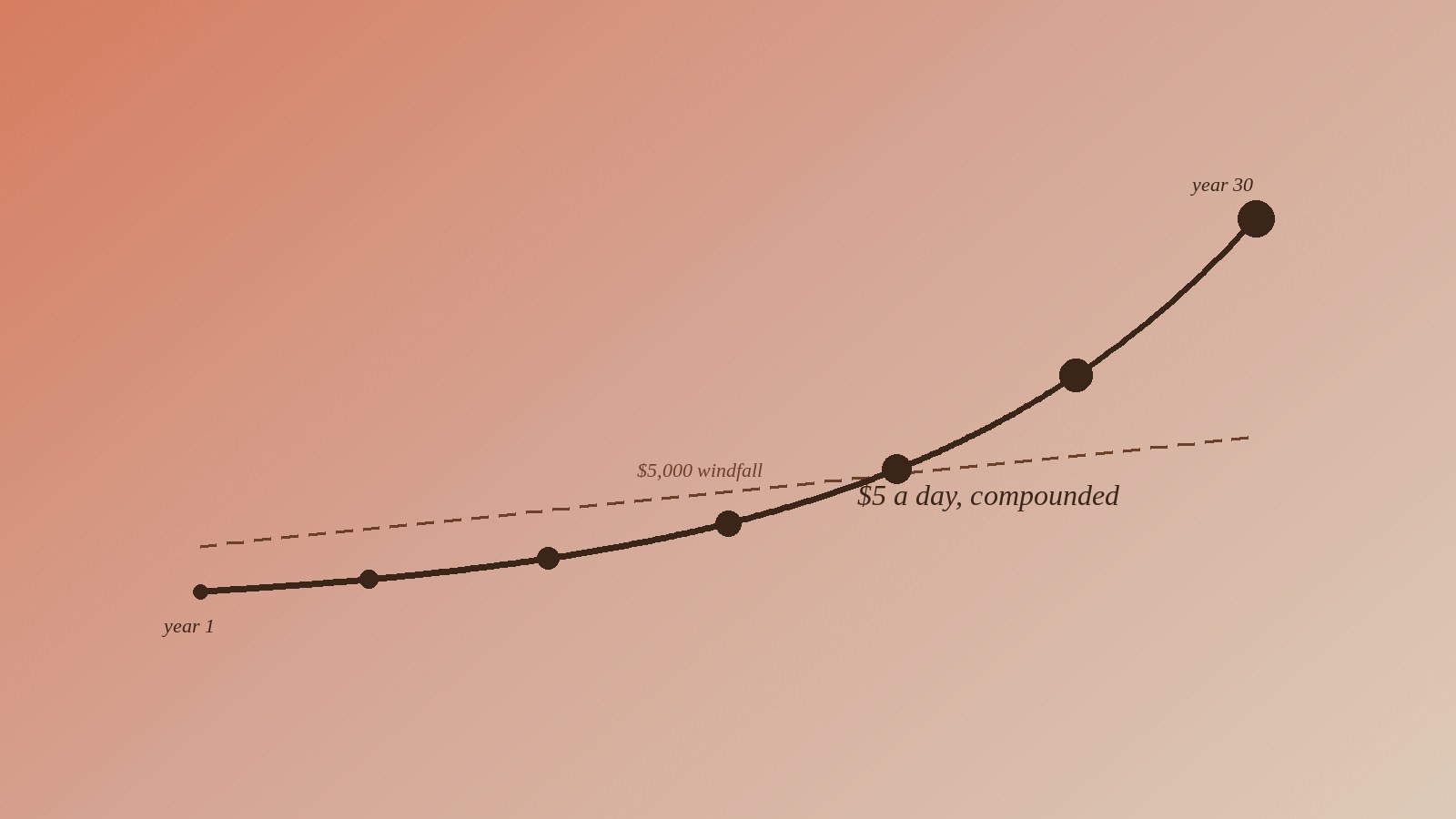
Scenario A: You win $5,000 today. Lottery ticket. Unexpected bonus. Whatever. Five grand lands in your account this afternoon. You do the responsible thing and invest it all in a simple index fund. You never touch it again.
Thirty years later, at a historical 8% average return, that $5,000 is worth roughly $50,000.
That’s good. That’s real money. If that was the whole story, you’d take it.
Scenario B: You save $5 a day. No windfall. No jackpot. You just set up an autodraft that pulls $5 a day — $150 a month — into the same index fund. You never think about it again. Some months you forget it’s even happening.
Thirty years later, that $5 a day is worth roughly $225,000.
invested once, 30 years
autodrafted, 30 years
from the habit
Four and a half times the windfall. From less than the cost of a fancy coffee. Quietly, while you lived your life.
This isn’t a trick and it isn’t a gimmick. It’s what compounding does when you give it time and frequency instead of asking it to work from a single moment.
The Thesis
The windfall is a coin.
The habit is a printing press.
And this is the thing most people get wrong about wealth: they’re waiting for the coin. They think the coin is the thing. And every day they spend waiting for the coin is a day the printing press isn’t running.
If the math is this simple, you’d think everybody would do it. They don’t. And I want to be honest about why, because I’ve failed at this more times than I’ve succeeded.
Five dollars feels like nothing. That’s the whole problem. Our brains are wired to pay attention to big numbers and ignore small ones. A $5,000 windfall feels like an event. A $5-a-day habit feels like a rounding error. The part of your brain that makes decisions doesn’t even register it as a thing happening.
Small actions don’t give you a dopamine hit. When you win $5,000, something in your chest goes up. When you save $5, nothing happens. No cheer. No text to your friends. No photo for Instagram. The very thing that makes the habit powerful — that it’s boring and small — is the thing that makes it impossible to stick with using willpower alone.
You can’t feel the compounding. Year one, $5 a day turns into about $1,900. That’s not life-changing. Year five, it’s about $11,000 — interesting, but still not dramatic. The exponential curve only becomes obvious around years fifteen to twenty, which is well past the point most people quit.
This is the ugly middle of every compound habit. You’re doing the work, you can’t see the payoff yet, and your brain is screaming that you should be doing something bigger. That’s where almost everyone stops.
This isn’t really about $5 a day. That’s just the most measurable version of the principle. The same math applies to every other habit that stacks small actions across long time horizons. And the ones that changed my life most weren’t strictly financial.
Pillar 01 · Money
A standing transfer to savings. One subscription audit per quarter. Checking your net worth on the first Sunday of every month — twenty minutes, no more. A rule that every raise goes at least half into savings before lifestyle inflation gets its hands on it.
Pillar 02 · Mind
Ten minutes of reading instead of scrolling before bed. A weekly review where you look at what actually happened versus what you planned. One hard conversation you’ve been avoiding, handled this week instead of next. These compound into a brain that makes better decisions with money — and with everything else.
Pillar 03 · Body
A walk after lunch. Eight hours in bed, even if only six of them are sleep. Protein at breakfast. Water before coffee. These aren’t fitness habits. They’re the hardware underneath every financial decision you’ll ever make, because a tired, under-fueled brain defaults to the most expensive option available every single time.
The compounding isn’t just that each habit grows over time. It’s that they reinforce each other. Better sleep means better focus, which means fewer impulse purchases, which means more savings, which means less financial stress, which means better sleep. The flywheel spins in whichever direction you’re pushing.
Push it down and it accelerates down. Push it up and it accelerates up. There’s no neutral.
The other reason people miss this is the opposite failure mode: they’re always one big move away from fixing everything.
When I get the promotion, I’ll start saving.
When I finish paying off the card, I’ll start investing.
When I launch the side hustle, the money will sort itself out.
When I lose the weight, I’ll have the energy to deal with the money.
I’ve said every single one of those sentences to myself. Some of them I said for years.
And the trap isn’t that these goals are wrong. It’s that waiting for them means you’re not building the habit right now — which means that when the big thing actually arrives, you don’t have the system in place to do anything useful with it. You get the promotion and your spending expands to match. You pay off the card and immediately put new debt on it. You launch the hustle and blow the first few checks on things you didn’t need.
The habit isn’t something you do after you get the win. The habit is how you turn any win — big or small — into something that lasts.
If you take one thing from this post, take this: the size of the habit you start with should feel embarrassingly small.
Not $5 a day if that’s a stretch. Start with $1 a day. Start with $10 a week. Start with the amount that’s so small your brain can’t come up with a reason to quit.
Because the number doesn’t matter in the first year. What matters is that the habit survives. A $1-a-day autodraft that runs for ten years is worth infinitely more than a $20-a-day habit that runs for three months and collapses.
And here’s the part that actually happens — I’ve watched it happen to me and to every person I know who stuck with this: once the habit is running, the number goes up on its own. You get comfortable. You notice you didn’t miss the dollar. You bump it to $2. Then $5. Then $10. Then you set up a second autodraft. Then you automate your raise. Then you wake up one Sunday, look at the numbers, and realize something has quietly been happening in the background for years.
That’s what wealth actually is, for most people who build it without inheriting it or winning it. It’s not a moment. It’s a background process.
The last thing I’ll say is this.
The windfalls still happen. I still get bonuses and tax refunds and occasional surprises. And now, because the habit is already running, I know exactly what to do with them — I just feed them into the system that’s already working. The windfall doesn’t have to change my life, because my life is already changing, every day, five dollars at a time.
This is the quiet math of compound habits. It’s the math the financial industry doesn’t want you to hear, because it can’t sell you a product for it. It’s the math the lottery doesn’t want you to hear, because it makes the ticket look ridiculous. It’s the math that a younger version of me would have dismissed as too small to matter.
It’s the math that actually works.
Five dollars is not a small number. Five dollars, repeated with discipline across a decade, is a different life.
Build the Habit. Own Your Future.
Mindful spending. Intentional saving. Lasting wealth.
— Omar at Wealthy Habits
Sources
S&P 500 historical returns (1928–2024) via the NYU Stern Damodaran dataset. Compound projections calculated at 8% annual return, monthly compounding — a defensible long-run nominal estimate, slightly below the ~10% nominal long-run average and above the ~7% inflation-adjusted real return. The “always one big move away” framing draws on Morgan Housel, The Psychology of Money (2020).
Keep building
Your First Budget in 30 Minutes · What Is Net Worth and Why It Matters · Emergency Fund: How Much Is Enough?
Leave a Reply