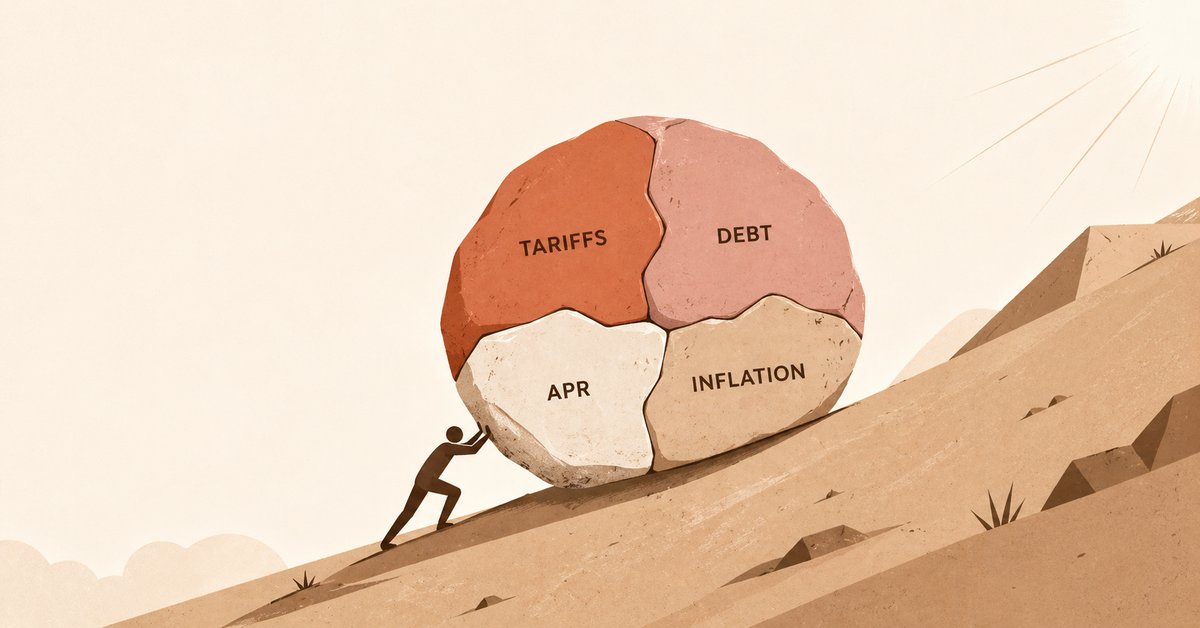

Something feels different this year. You’re doing the same things — same job, same habits, same grocery store — but it feels like you’re making less money. Savings feel harder to build. Debt feels harder to shake.
You’re not imagining it. Four separate financial forces are converging on household budgets right now. Here’s what they look like in one place.
The Four Things Hitting Your Wallet Right Now
Sources: Yale Budget Lab (April 8, 2026); Federal Reserve Bank of New York, Q4 2025; LendingTree; U.S. Bureau of Labor Statistics, March 2026 CPI
Okay — sorry if those stat cards just punched you in the chest. They kind of punched me in the chest too. I’ll be honest: I’ve been reading a lot of personal finance takes on 2026 lately, and most of them are either pretending everything is fine or telling you the world is ending. The truth is somewhere in between, and I wanted to actually talk through what’s happening — and what you and I can do — without pretending things will just work themselves out.
So let’s walk through it together.
Why Tariffs Feel Like a Tax You Never Voted For
Tariffs are taxes on imported goods. Businesses pay them at the border, then they almost always pass the cost on to you at the register. The Yale Budget Lab estimates the current regime is costing the average household between $760 and $940 a year. That’s a real number — buried in your everyday purchases, and not evenly distributed.
“The burden on the lowest-income households runs about three times that of the top-income households — as a share of income.” — Yale Budget Lab, April 2026
In plain terms: the less you earn, the bigger the bite. And here’s where your spending is most exposed right now.
Source: Yale Budget Lab, April 8 2026 tariff analysis
The Gas Story Nobody’s Really Talking About
I want to pause on that March inflation number for a second, because it’s easy to miss what’s actually driving it. The headline jumped from 2.4% in February to 3.3% in March — and almost three-quarters of that came from gas. Gasoline prices surged 21.2% in a single month after the Iran war started at the end of February. That’s the biggest monthly gas spike since 1967.
I’ll be real with you — I bought a truck recently. Not exactly the best timing for a fuel-sensitive purchase. Between the Iran war pushing oil up globally and California’s ongoing gas tax situation (the state’s excise tax alone is already the highest in the country at over 70 cents per gallon, and the LCFS changes are still working their way through), I’ve been feeling every fill-up. If you’re in California, you already know.
Here’s the thing: gas doesn’t stay at the pump. It shows up in grocery prices, shipping surcharges, delivery fees, airfare — basically anything that moves on a truck, a plane, or a ship. Which is almost everything. Amazon just added a 3.5% fuel surcharge on third-party sellers starting April 17. The airlines are raising baggage fees. That’s the trickle. You feel it everywhere.
The Credit Card Trap Is Getting Worse
Americans now owe a record $1.277 trillion in credit card debt — the highest the New York Fed has ever recorded. And about 60% of people carrying a balance have been carrying it for at least a year. That’s not a fluke. That’s a pattern.
Here’s the math that matters: carrying a $5,000 balance at the average 23.72% APR and only making minimum payments, you’ll pay over $1,800 in interest over two years — and still owe most of the principal. I wrote more about this in America’s Credit Card Crisis if you want the deeper breakdown.
The Fed held rates steady at the April meeting, and the path forward is murky. I wouldn’t count on rate cuts saving you — they may not show up in time to matter for your current balance.
5 Moves to Make Before May
You can’t control tariff policy or Fed decisions. Neither can I. But there are five things worth doing this month that I genuinely think are worth your time.

The Bottom Line
2026 is genuinely harder on household budgets than most years. Tariffs, record debt levels, high interest rates, and war-driven inflation aren’t going to resolve themselves by summer. I won’t pretend otherwise.
But you don’t have to do all five moves this week. Pick one. Start this week. That’s the whole action step — not a budget overhaul, not a financial plan. One move. One week. That’s how I’m thinking about it too.
Sources: Yale Budget Lab, State of U.S. Tariffs, April 8 2026 · Federal Reserve Bank of New York, Household Debt and Credit Report, Q4 2025 · LendingTree 2026 Credit Card Debt Statistics · U.S. Bureau of Labor Statistics, March 2026 CPI release · U.S. Energy Information Administration, state gasoline taxes as of January 1, 2026.
Leave a Reply