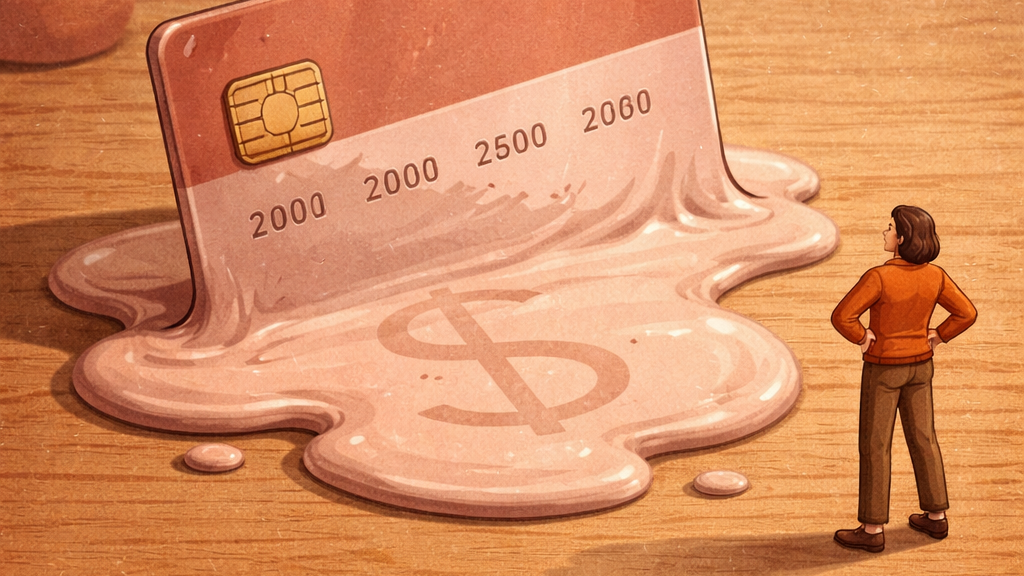
Credit card debt in America just hit a record $1.28 to $1.3 trillion. That number is almost too large to feel real — until you zoom in. About 111 million Americans, roughly half of all credit card holders, are carrying a balance they can’t pay off at the end of the month. That’s up 17% from five years ago.
A Debt.com survey found that 55% of U.S. adults are now using credit cards as a primary financial lifeline — not for rewards, not for convenience, but to cover groceries, rent, and utilities. This isn’t lifestyle debt. It’s survival spending.
The Credit Card Crisis by the Numbers
Sources: Federal Reserve Bank of New York, Q4 2025; Debt.com Survey, 2026
How We Got Here
The short version: costs went up faster than wages, and credit cards filled the gap. When rent, groceries, and insurance all climb in the same year — while your paycheck stays relatively flat — a credit card starts to feel less like a tool and more like a necessity.
The problem is that credit card debt is among the most expensive debt you can carry. At an average APR of 23.7%, a $5,000 balance costs you roughly $1,185 in interest over a single year if you’re only making minimum payments. That’s money that could have gone toward an emergency fund, a car repair, or next month’s groceries.
The cycle is self-reinforcing. You carry a balance because you can’t cover expenses. The interest charges make covering expenses harder. So the balance grows.
What 23.7% Actually Costs You
Most readers carrying a balance couldn’t tell you what it’s actually costing them. Here’s the math on a $5,000 balance at the national average APR, depending on how you attack it:
$5,000 Balance at 23.7% APR
Estimates based on 23.7% APR; minimum payment assumed at 2% of balance. For illustration only.
The Political Wild Card: A 10% Rate Cap
There’s a proposal circulating in Washington to cap credit card interest rates at 10%. It hasn’t become law, and may never. But the number itself tells you something important: a 10% cap would cut the average APR by more than half. That’s how far current rates have drifted from what most consumers can realistically afford.
The supporting math is striking. Analysts estimate a 10% cap would save American cardholders approximately $368 million in interest charges every single day. That’s the size of the gap between current rates and a number that would feel normal in any other lending market.
Don’t build your payoff plan around a proposal that may not pass. Control what you can this week.
What You Can Do Right Now
If you’re carrying credit card debt, here’s the honest priority order:
Your Credit Card Action Plan
Log into every card and write down the APR and current balance. Most people are fuzzy on both.
It works more often than people think — especially if you’ve been a long-time customer with a decent payment history.
A 0% intro APR card can buy you 12–21 months of interest-free paydown time. Watch the transfer fee (usually 3–5%).
Debt avalanche (highest rate first) saves the most money. Debt snowball (smallest balance first) builds momentum. Both work — pick one.
Even small new charges keep the clock running. If the card stays in your wallet, consider freezing it — literally — until the balance is gone.
Source: Consumer Financial Protection Bureau — Managing Credit Card Debt
If You’re Using Cards to Cover Basics
This is the hardest conversation to have, and the most important. If you’re charging groceries because there’s nothing left in your account, the problem isn’t the credit card — it’s a gap between income and expenses that a payoff strategy alone won’t close.
Start here: write down your monthly take-home income and your fixed monthly expenses. If the gap is negative, you need to address that before anything else — whether that means cutting a recurring cost, picking up extra income, or both. The credit card balance won’t shrink if the root cause is still open.
If you haven’t built a working budget yet, start with Your First Budget in 30 Minutes — it walks you through closing the income-expense gap step by step. And if you want to see how credit card debt fits into your overall financial picture, What Is Net Worth and Why It Matters shows you why the liabilities column matters as much as the assets column.
Your Action Step
This week: pull up every credit card account you have. Write down the balance, the APR, and the minimum payment. Total them up. That number — however uncomfortable it is — is your starting point. You can’t make a plan around a number you’re avoiding.
Sources: Federal Reserve Bank of New York, Household Debt and Credit Report, Q4 2025 · Debt.com, 2026 Consumer Credit Card Survey · Consumer Financial Protection Bureau, Managing Credit Card Debt · The Century Foundation & Student Borrower Protection Center, analysis of U.S. credit card debt trends.
Keep building
Your First Budget in 30 Minutes · What Is Net Worth and Why It Matters · I Was Bleeding Money, Running on Fumes, and Couldn’t Think Straight
Leave a Reply