Investing · 9 min read

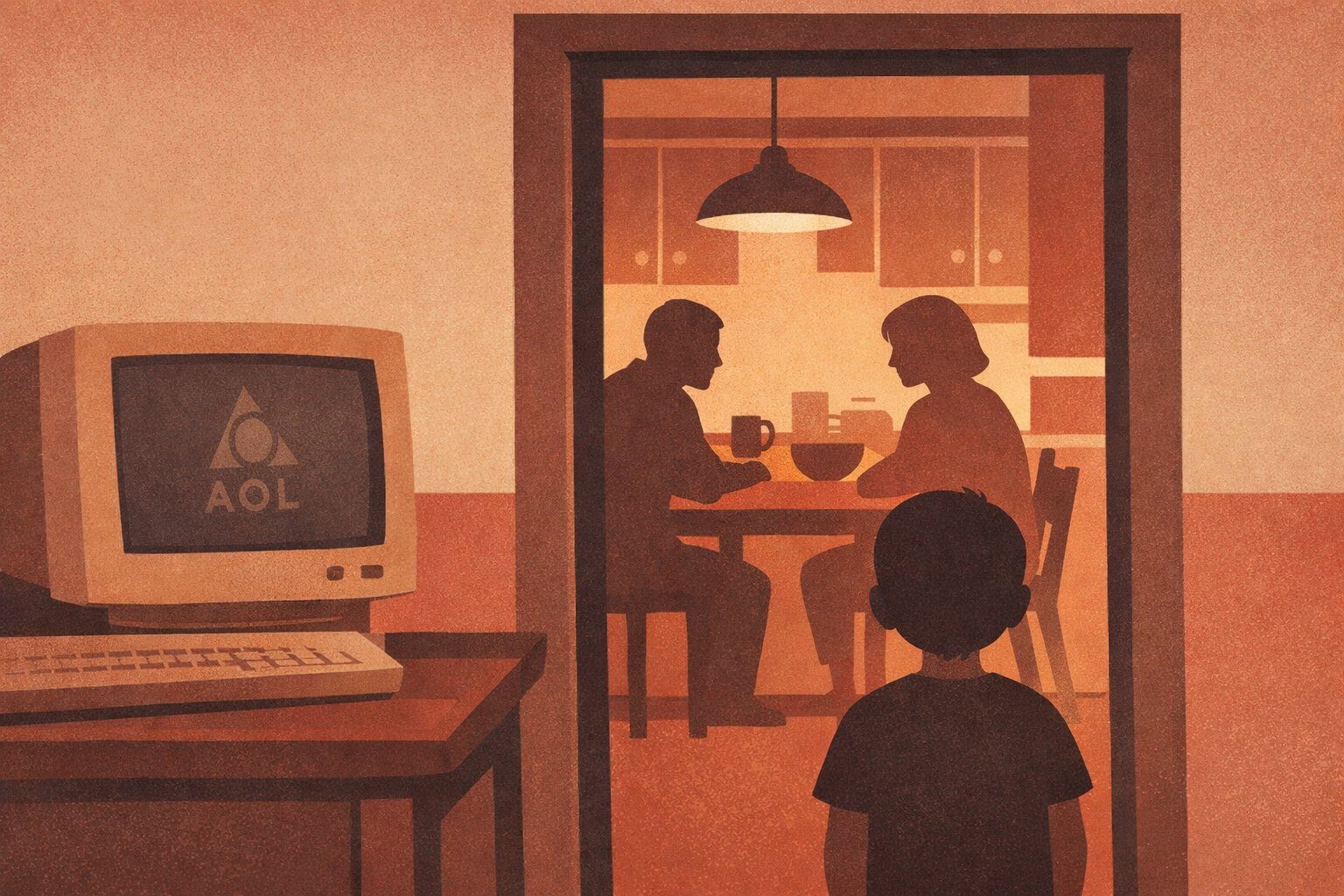
When I was 12, my parents asked me if they should invest my college money in AOL.
I remember the moment clearly. I had no idea what a stock was. I had no idea what it meant to invest in one. What I did know was that I had heard of AOL — everybody had — so I said sure, seems fine. That was the extent of the financial analysis.
A few months later, I overheard my parents in the kitchen talking in that low, tight voice parents use when they think you can’t hear. The money was all but gone. Nobody sat me down to explain what had happened. We didn’t talk about money at all.
Inheriting financial trauma

The story our families imparted on us about money likely still runs the show, and most of us don’t even notice it happening. Maybe our parents lost a chunk of their retirement in 2008. Maybe a grandparent rode the dot-com bust down to almost nothing. Maybe, like me, you were also a victim of a single stock disintegrating before our eyes.
Whatever the specifics, these stories ingrain in us that: investing is risky, the market is rigged, and regular people get burned.
I thought I was alone in my outlook and financial position. Destined to live paycheck to paycheck. Turns out a guy named Jim Cramer — yes, that Jim Cramer — has been telling his version of this story for years. His dad lost everything on a single stock called National Video. Cramer watched it happen as a kid, and said recently that he’d been “willing to expose” his parents as not knowing what they were doing, because, in his words:
“I was a creature of them not knowing and a creature of us losing all our money. And I didn’t want that ever to happen.”
— Jim Cramer, Big Technology podcast, December 2025
That’s the whole thing in two sentences. We become creatures of what our parents didn’t know and what our families lost because of it. The trauma isn’t the loss itself — plenty of families lose money and move on. The trauma is the silence around it, the shape our parents’ fear took afterward, and the version of that fear we inherited without ever being told.
It shows up in the data

I recently read a 2021 study that tracked parents and their adult children and found that parents’ stock market experiences measurably shape their kids’ investing decisions — decades later. Not through genetics. Through the conversations and behaviors that we absorb growing up.
Parents who pulled out of the market passed that instinct on. Parents who stayed in passed that on, too. We’re not imagining the weight we feel when we think about opening a brokerage account. We inherited it. And the tricky part is that it doesn’t feel like an inherited belief — it feels like common sense.
The market didn’t do this to our families. A specific moment in the market, combined with specific decisions made under stress, did. Those are very different things.
What actually happened in the crashes we heard about

Here’s the part nobody walked me through when I was 12. Every major crash in modern history has something in common: the market came back. Not always fast. But it came back.
Source: S&P 500 historical data, Morningstar, BNY Investments
Even more recently, the April 2025 tariff crash dropped the S&P 500 nearly 19% in a matter of weeks — and by late June, the index had fully recovered and hit a new all-time high. Same pattern. Different headline.
Whoever in our families “lost money in the market” almost certainly lost it at a specific moment — usually by selling at the bottom, or by being concentrated in a single company that didn’t survive. My family’s money went into one stock. Cramer’s family went all-in on another one. That’s what killed it. Not the market.
Someone who bought broad index funds in 2007, did nothing, and waited was whole again by 2013 and had nearly doubled their money by 2020. We’ve probably heard the 2000s were a lost decade for stocks — and from 2000 to 2010 the S&P 500 did return less than 1% a year. What nobody says next is that from 2010 to 2020 the same index returned close to 14% per year. Across the full 25-year stretch from 2000 to 2025, through four crashes and a pandemic, the S&P 500 returned roughly 7.6% annualized. That’s the actual story of the market our families told us about.

S&P 500 monthly closes. Source: Federal Reserve Economic Data (FRED) and historical index records.
The market doesn’t punish people who invest. It punishes people who only invest at the top and only sell at the bottom.
How I started investing
It was baptism by fire. I probably bought at the worst time possible, and definitely bought the worst stock. Solana. I had been listening to a podcast that Tim Ferriss released on a weekly basis about starting businesses, maximizing life, sleep and finances. One episode in particular mentioned a “crypto coin” that I had never heard of before, which is not surprising because I had only heard of Bitcoin at that time. Solana sounded like the best thing since sliced bread, and I invested 90% of my savings into it right before the crypto crash.
During this time, Solana (SOL) experienced a dramatic 97% crash from over $250 in November 2021 to around $10 in January 2023. I wanted to sell. I wanted to quit. The main reason I didn’t sell was because I didn’t know what I would do with the minuscule amount of money I would yield. So instead, I invested the remaining 10% of my savings into an index fund rather than crypto or another single stock, because the thing that broke my family was betting on one company, and I was not about to repeat that.
I automated everything, because the less I had to decide each month, the less the old AOL voice in my head got to weigh in. And I kept my emergency fund completely separate, because a lot of family losses happen when a market crash hits at the same time as a job loss or a medical bill — people don’t sell because the market’s down, they sell because rent is due.
The biggest thing that helped, honestly, was deciding ahead of time what I’d do the next time the market dropped 20%. Writing it down. “Nothing. Keep contributing.” Having it on paper gives the calm version of us something to show the panicked version of us later.
We’re not betraying them by investing

Here’s the part that nobody talks about. If our parents got hurt by the market, doing it differently ourselves can feel like saying they were wrong. Like we’re stepping over them. Getting it right where they got it wrong.
I sat with that feeling for a long time. Every time I looked at my index fund I could hear my parents saying the market’s a casino, the game is rigged, regular people don’t win. And every dollar I added felt like a small argument with them that they didn’t know I was having.
Here’s what I eventually figured out: they weren’t wrong about their experience. They put money into a single stock, that stock collapsed, and they lost real money that was supposed to be for me. That happened. The part they got wrong was the lesson they pulled from it — that the market itself is the problem — and the silence they built around the whole thing afterward. We don’t have to inherit the lesson or the silence.
We have tools they didn’t have. Index funds instead of single stocks. Automatic contributions instead of one scary deposit. Tax-advantaged accounts. Decades of data showing what works. Using what we have isn’t a judgment on them. It’s the thing they probably hoped we would do.
The generation that got burned didn’t lose so we’d be afraid. They lost so we’d know what to avoid.
One step we can take today

Open a brokerage account. It doesn’t have to be funded today. It doesn’t have to have anything in it today. Just open it.
I remember opening mine. I sat on the app for probably 40 minutes before I actually pressed the button to link my bank. Nothing was happening. No money was moving. No stocks were being bought. And I was still nervous. That’s how deep the AOL voice runs — even the setup screen felt like standing at the edge of something.
The hardest part of breaking an inherited money story is proving to ourselves that the first step is survivable. Opening an empty account is survivable. And once it exists, the next step — a $50 automatic deposit into a total market index fund — becomes a decision we can make on a calmer day.
My parents are well into retirement now, and to this day, they still don’t invest in the stock market. Every time I think about that, I remember the kitchen, the low voices, the 12-year-old kid being asked to vote on AOL. And I think about how the silence after that moment — the fact that we never talked about money, then or since — cost us more than the stock ever did.
Somebody in every family line has to be the one who learns it and passes it forward. Let’s be those people. Start with an empty account. The rest follows.
Keep building
Index Funds for Beginners · Roth vs. Traditional IRA: Which Is Right For You? · High-Yield Savings Accounts Explained
Sources: Jim Cramer on Big Technology podcast with Alex Kantrowitz, December 2025 (via Benzinga/Yahoo Finance, March 2026); Zhao & Cui (2021), “Investing Like My Parents”; S&P 500 historical data via Federal Reserve Economic Data (FRED) and Wikipedia; Morningstar 150-year bear market analysis; J.P. Morgan Private Bank “Liberation Day” analysis (2025); BNY Investments.
Leave a Reply